The Minimap Glance: Read the Route, Keep the Fight
You are escorting a moving objective through a narrow street when an ally’s icon disappears from the minimap. Looking down for a full second might reveal the approaching flank, but it could also hide the opponent stepping out of the doorway ahead.…
You are escorting a moving objective through a narrow street when an ally’s icon disappears from the minimap. Looking down for a full second might reveal the approaching flank, but it could also hide the opponent stepping out of the doorway ahead. The useful skill is not watching both displays equally. It is choosing when to glance, what question that glance should answer, and where your eyes should return. In this situation, first reach the wall beside the objective, check whether the side street is covered, then return your attention to the doorway before moving again.
Set up the minimap so a quick look produces a readable answer. During a quiet opening section, check whether you can distinguish your position, nearby allies, and the next intersection without leaning toward the screen. If the interface allows adjustments, enlarge the map enough to separate overlapping icons, but avoid covering the area where nearby threats usually appear. Test the result while moving past a doorway: can you still see someone emerging at the screen’s edge? A larger map is not automatically better if it conceals the very action you are trying to keep watching.
Use protected movement as your first opportunity to build a glance habit. Suppose you have just crossed a courtyard and are now following a solid wall toward the next corner. While that wall blocks the most likely enemy sightline, briefly check the minimap for allied coverage beyond the corner. Return to the main view before reaching the wall’s end. This makes the glance fit inside an existing period of lower visual demand. Do not stretch the check simply because the map contains more information; the approaching corner sets the deadline for looking up.
Give each glance one question rather than attempting to read the entire match. At a three-way junction, your question might be, “Which route has an ally nearby?” You need only locate the relevant icons and compare the branches. You do not also need to inspect the distant objective, count every opponent marker, and reconsider your whole route. Once the immediate question is answered, return to the junction on the main screen and choose your turn. A narrow question makes the map useful without turning a momentary check into an extended search.
When direct contact begins, let the main screen take priority. If an opponent appears across the street, keep watching their movement, your aiming area, and the cover between you. A fresh minimap marker can wait until you have broken the sightline or otherwise reached a safer position. For example, after retreating behind a concrete barrier, check whether a second opponent could approach from the adjacent lane. Then look back toward the barrier’s exposed edge. The map helps you prepare for the next danger; it should not distract you from an opponent already visible.
Treat disappearing icons as uncertainty, not as proof of a particular move. If an opponent was last marked near the northern passage, a quick glance tells you where they were seen, not necessarily where they are now. Keep your main-screen attention on the entrance they could realistically reach next. In the escort example, that might mean leaving more space from a side doorway while continuing along the objective’s route. Avoid repeatedly staring at the empty patch of map, hoping the icon will return. Convert the missing information into a cautious viewing angle instead.
Check the map before crossing exposed ground, while you can still delay the movement. From behind a parked vehicle, look for nearby friendly positions and any currently visible threat markers. Then bring your eyes back to the actual crossing: identify the far cover, inspect the closest opening, and commit only when the main view supports the move. Friendly icons on the opposite pavement may suggest support, but they do not guarantee that every window is safe. Once you start crossing, watch the space ahead rather than checking whether the map still looks reassuring.
Use communication to shorten the search rather than lengthen your distraction. If a teammate named 1gom marks the eastern stairs, first notice whether those stairs are already visible on your main screen. If not, make a brief map check to establish their direction, then return your eyes to your current lane. A useful reply is a simple acknowledgment or a concrete observation about your own view. There is no need to keep studying the marker while the teammate explains it. The purpose of the callout is to focus attention, not to hold it away from nearby action.
During a retreat, read the route in stages instead of navigating continuously by the minimap. Behind cover, check which passage leads toward your team. Look up, travel to the next protected point, and reassess there if needed. This prevents a common mistake: following your own moving icon while colliding with scenery or missing someone directly ahead. If you take an unexpected turn, stop somewhere defensible before correcting the route. A slightly slower retreat with eyes on the path is often more controlled than a direct route followed almost entirely through the map.
After a missed threat, review the timing of the glance rather than simply deciding to check more often. Ask what was happening on the main screen when you looked away, what you wanted to learn, and whether you stayed on the map after finding it. If you missed someone leaving a doorway, the adjustment might be to glance earlier, while the doorway was still blocked by cover. Practice that specific change on the next approach. The goal is a repeatable sequence: identify a question, use a suitable pause, read the relevant map detail, and return to the live scene.
Keep listening
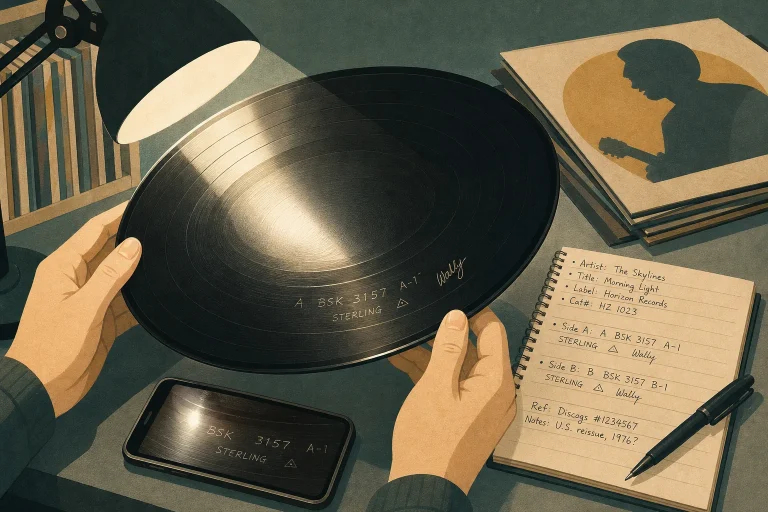
The Runout Groove: What the Record’s Final Spiral Can Tell You
The runout can help identify a record’s pressing, but its marks are clues rather than a…