A Record Shelf That Makes Its Collection Easier to Browse
A week of small decisions can turn a crowded record shelf into a system you can use without consulting a private theory of alphabetical order.
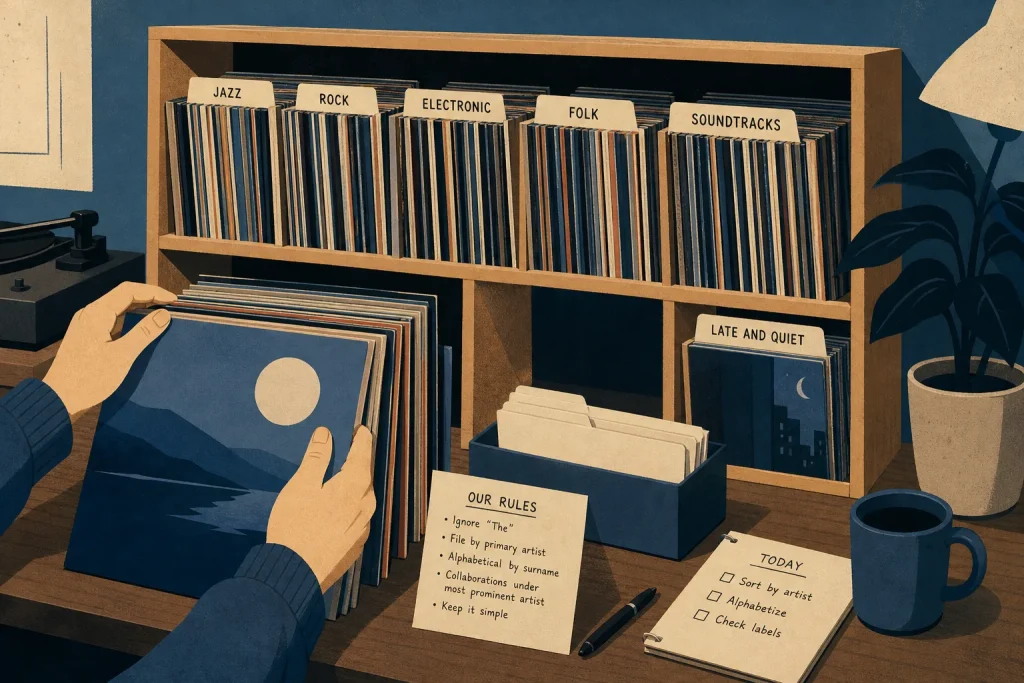
You pull a record from the shelf, then discover its neighbors have shifted into a leaning stack. The album you wanted is somewhere between a soundtrack and a sleeve with a similar shade of blue. A useful organizing system should make that ordinary search easier, not require a second hobby in catalog management.
Give the shelf a week of modest attention. The aim is not to impose one correct order on every collection. It is to choose an arrangement that matches how you look for records, make it visible, and give returned albums a reliable place. A small collection may need nothing beyond clear dividers; a larger one may benefit from a simple catalog as a backup.
Choose the search you make most often
Before moving anything, notice what you ask yourself when you want to play a record. Do you think of the artist, the album title, a genre, a mood, or the sleeve you remember seeing? The best primary order follows that first question. Everything else is a possible secondary aid, not a reason to build a system with more rules than the shelf can support.
Artist order is a useful default if you usually reach for a musician or group by name. It makes a growing collection reasonably easy to scan and keeps an artist’s albums together. Album-title order can suit a collection centered on familiar records whose artists escape you in the moment. Genre works for people who choose by sound, though it asks you to decide where border-crossing records belong. A shelf arranged by personal use—quiet evenings, dance records, soundtracks—can be inviting, but those categories are subjective and may overlap.
During a few ordinary listening sessions, jot down what you searched for and where you expected the record to be. If your hand goes to an artist’s name, sort by artist. If it goes to a broad sound or occasion, consider genre or a limited set of use-based sections.
Say you remember an album as a late-night listen but cannot recall its artist. You decide to create a “Late and quiet” section and place the album there, along with other records you would plausibly choose for that mood. The expected result is that you can scan this small group rather than search every artist. If the section becomes a catchall, narrow it or return those records to artist order.
Set one primary order and keep its rules plain
Choose the primary order and write its rules on a card or in a note on your phone. Plain rules are easier to use than clever ones. For artist order, decide how you handle “The,” solo artists, bands, and collaborations. You might file an artist under the name most prominent on the cover and ignore an initial “The.” What matters is applying that choice consistently enough that you remember where to look.
Alphabetical filing by artist is not the only sensible version. You could group all records by an artist together, then order that artist’s albums by title or release sequence if that helps you browse. If you prefer album titles, keep titles together regardless of performer and use the spine text as the main cue. For genre, select broad labels you can recognize at a glance—jazz, rock, electronic, folk, classical—rather than making a new division for every subtle distinction. A record can be difficult to classify. That is a property of music, not a personal failing.
Use a small number of dividers to mark sections. Sturdy index cards or blank dividers made for record storage work well as labels. For sleeves and other materials that touch records or jackets, look for products explicitly identified by their manufacturer as suitable for vinyl records, and check the product description for the intended use. “Archival” or “archival-safe” is not a precise material specification by itself; if the maker does not say what the product is made for, choose a clearly described record-storage product instead. Keep labels smooth and free of sharp edges that could catch a sleeve. If a divider has a projecting tab, make sure it does not press against delicate jackets.
Keep records upright and supported so the row does not slump when one is removed. Avoid packing them so tightly that you have to tug at a jacket; avoid leaving so much empty space that a small group leans. If the shelf has several compartments, assign a clear section to each instead of letting categories drift across the furniture. The practical test is simple: a record should come out and go back without forcing its neighbors into an argument.
Move the collection in manageable passes
Start with one shelf or compartment. Put records in a temporary row or on a clean, stable surface, keeping them upright where possible. Handle jackets with clean, dry hands and avoid setting sleeves near drinks, food, or a busy edge. This is not the time to create a floor-level maze around the turntable.
Separate only what the new system requires. If you are sorting by artist, collect records by artist and then alphabetize them. If you are creating genre sections, make the broad groups first and leave uncertain records in a temporary “decide later” group. When a record seems to fit two sections, choose where you would first search for it and file it there.
Work in passes. First make the broad divisions; then arrange records within each division. Pause before moving to the next compartment, and check that the labels still match the records beneath them. If the shelf is large, divide the task across several sessions. There is little benefit in rushing, then discovering that the last row has been alphabetized according to a rule you invented while tired.
Add secondary cues only when they address a real browsing problem. If you use genre divisions but often seek a particular performer, a simple catalog can help. If the collection is modest and artist order already works, a catalog may add effort without improving the search. Secondary systems should answer specific questions, such as “Which records do I own by this artist?” or “Where did I file the soundtrack?” They do not need to duplicate every detail on every jacket.
Choose a backup that you will actually maintain
A paper list kept near the shelf is easy to consult and does not depend on a device. A spreadsheet in Google Sheets or another familiar program can sort by artist, title, or genre and can include a shelf location. A collection app may offer convenient fields and scanning features, but check that its cataloging method suits the records you own before entering a large collection. The useful tool is the one you will update after a new record comes home.
Keep the record of your system modest. A spreadsheet might use columns for artist, album title, primary section, and shelf location. Add pressing or condition details only if you have a real reason to track them. For a physical shelf, a location such as “living room, left compartment” can be more helpful than an elaborate code that only makes sense to its creator.
Enter a small sample of records and try searches you commonly make. If you want a particular artist, can you find the relevant entry? If you use shelf locations, do they match the labels and actual arrangement? Correct confusing headings now rather than building a polished catalog around a filing scheme you already dislike. A spreadsheet that lists what you own but cannot tell you where it is may still be useful, but it is not a shelf map.
Do not let the catalog become a second, competing order. The shelf has one primary arrangement; the backup offers other ways to search it. If the shelf is organized by genre, the spreadsheet can sort by artist. If the shelf is alphabetical, a note or filter can group records by listening context. This division of labor keeps the physical system legible while preserving alternate routes through the collection.
Make returning records part of the system
Test the routine in ordinary use. Take records from different sections, listen as you normally would, and return each one to its assigned place. Notice any point where the correct slot is unclear. A record that is easy to locate but awkward to return will eventually migrate into a nearby stack, where it begins a small and entirely predictable rebellion.
Choose a return habit that fits your room. You might put played records in a temporary upright holder beside the shelf, then file them after the listening session. Or you might return each album immediately, using the divider to find the gap. A holder should be stable and should not leave records leaning for long periods. Avoid stacking records on a turntable lid or balancing them where a passing elbow can make an editorial decision.
Use inner and outer sleeves suited to your storage practice, following the maker’s stated use and handling directions. Slide jackets back into the shelf carefully. Do not force a record into a packed row simply because that is where it used to live. If a section has become crowded, adjust the shelf layout or give the section more room. The arrangement is there to serve the records and the person who reaches for them; preserving an old boundary is not a virtue in itself.
If you share the shelf, make the rules visible to the other people who use it. A note inside a cabinet door can explain the primary order and any unusual filing choice. Keep it brief: “Artist order; ignore ‘The’; compilations under Various Artists” is more useful than a private essay about the metaphysics of compilation albums. Agree on the broad approach, then accept that a borrowed record may return slightly out of line. The system should survive ordinary company.
Review the arrangement after a week
Check how the shelf behaves. Can you find records using the search you chose? Are the labels readable? Are there sections that make you hesitate every time? Does the return routine work, or has a pile appeared beside the shelf? These observations are enough to decide whether to keep the arrangement, simplify it, or change one part.
Make one adjustment at a time. If genre boundaries keep causing indecision, merge the narrowest sections into broader ones. If artist order works but you want to browse by mood, add a small separate listening list rather than rearranging the whole shelf. If the catalog is falling behind, remove fields you rarely use or stop maintaining it. A system that asks for more attention than it returns is a candidate for revision.
Once the arrangement settles, leave room for new records in the sections where they are likely to land. That may mean keeping an open span in each compartment or using a neighboring shelf for overflow. Avoid treating every empty space as a problem to solve. It is useful working room, and records tend to arrive without consulting the furniture first.
Revisit the rules whenever you notice a repeated search failing. Collections change, and so do the ways their owners browse them. Keep the primary order obvious, label only distinctions you use, and make returning a record as easy as finding it. A shelf will not remember your system for you, but a clear divider usually has a longer memory than a tired listener.
Keep listening

Listening to an Album Without Reading Along
Set aside the lyrics, reviews, and urge to identify every sound. A simple sequence of listening…

Three Ways to Sequence a Playlist for a Long Train Ride
Mood-led, pace-led, and chapter-based sequencing each shape a journey differently. Choose the approach that suits the…