The Runout Groove: What the Record’s Final Spiral Can Tell You
The runout can help identify a record’s pressing, but its marks are clues rather than a complete history. Learn which details matter, what needs context, and how to choose a useful approach to reading them.
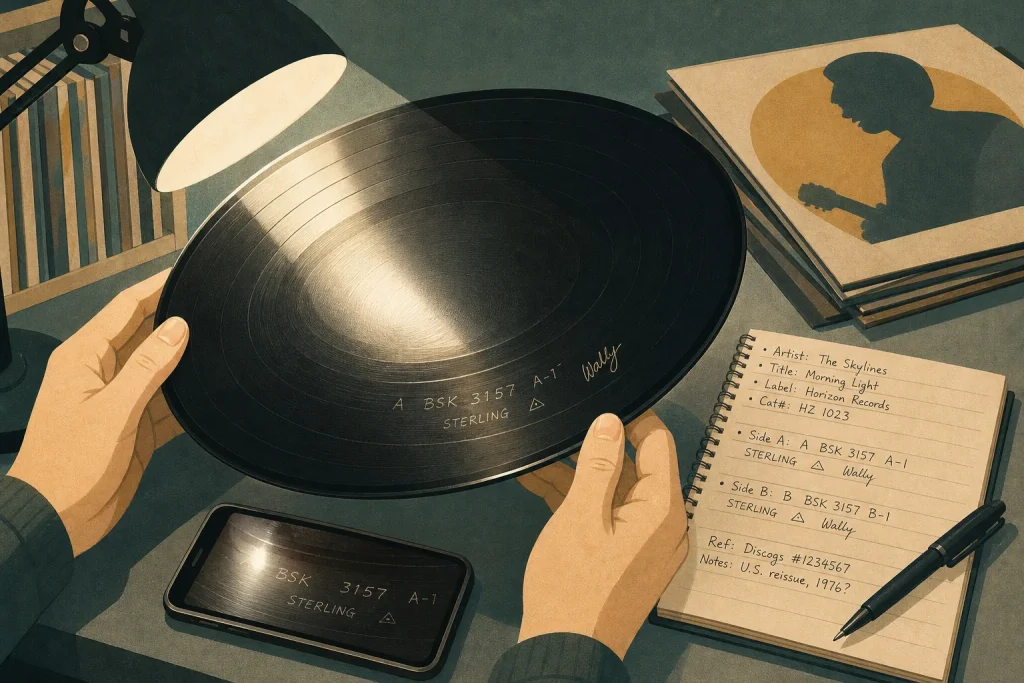
You lift a record from its sleeve after the last song, and the music gives way to a faint, repeating tick. Near the label, the grooves end in a blank-looking band of vinyl. Tilt the record under a lamp and tiny letters appear, scratched or stamped into the surface. That narrow area is the runout, also called the dead wax, and it can help identify a pressing—provided you know which marks are doing useful work and which are merely along for the ride.
There are a few ways to read it. You can use the runout as a quick clue while browsing, compare the full inscription against a reliable discography when identifying a specific copy, or keep a modest record of the markings in your own collection. Each suits a different purpose. The choice depends on whether you want to decide what to buy, settle an identification question, or simply remember what is on your shelf.
The runout is a clue, not a biography
The runout is the smooth or lightly grooved area between the recorded program and the label. It may contain a matrix number, side designation, catalog information, mastering or cutting marks, plant identifiers, and short messages added by an engineer. Some records have several kinds of inscription; others have little beyond a number. A mark may be etched by hand, pressed into the metal parts used in manufacture, or appear in a combination of styles.
That variety is why a single letter or symbol rarely identifies a record on its own. A catalog number may connect the disc to a release, but it may also appear on multiple pressings. A matrix number can distinguish sides or cutting versions, yet its format varies by label and era. A mastering signature can point toward a particular engineer or facility, but only if the handwriting or code has been interpreted correctly. Even a clear, familiar mark needs the surrounding details.
Think of the runout as a set of clues with different levels of usefulness. The most useful question is not “What does this one mark mean?” but “Which details agree with the label, sleeve, format, and known versions of this release?” The disc itself is giving evidence, not writing an autobiography.
A quick visual read suits browsing
If you are standing at a record shop counter, a quick read is usually enough to decide whether a copy merits more attention. Look for the matrix or catalog sequence, the side identifier, and any obvious extra inscription. Check whether the label design and catalog number make sense together. A phone flashlight can help reveal faint etching, though a strong angle of light often works better than shining it straight down. Keep the record supported by its edges, and do not drag a fingernail across the grooves to trace a mark.
This approach suits a buyer who has a particular pressing in mind but does not need to settle every detail before deciding. A runout that matches a known version can be encouraging; one that differs may point to another cut or pressing. Neither result says much about the record’s sound or condition by itself. Those are separate questions, best answered by inspecting the surfaces, listening where possible, and checking the seller’s description.
Say you are browsing for a reissue whose label and sleeve resemble an older copy you already own. You find a matrix sequence that differs from the one you expected, while the label and catalog number match the reissue. You note the difference, take a clear photo with your phone, and compare it later with a discography. The observable result is a more informed identification before you buy, not a verdict about which copy sounds better.
The limitation is easy to miss: a quick glance can make a mark look more decisive than it is. Handwritten characters can be ambiguous, and a familiar code might have been reused. Treat the shop-floor read as a screening method, not a certificate of pressing ancestry.
A full comparison suits exact identification
When you need to distinguish among closely related editions, compare the whole record with a reference entry rather than searching one inscription in isolation. Discogs can be useful for collecting user-submitted release details, while label catalogs, specialist discographies, and photographs of confirmed copies may provide additional context. Reference entries are not infallible, and user-entered information can be incomplete or attached to the wrong variant. Look for agreement across several details rather than treating one database line as an official ruling.
Record both sides. Note the complete matrix sequence, including side letters, suffixes, and symbols, then compare the label text, catalog number, country or region indicated on the release, and sleeve variations. Separate what you can read directly from what you infer. For example, “etched letters read as X and Y” is an observation; “cut at a particular studio” is an interpretation unless a dependable reference supports it.
This approach suits collectors who care about a specific edition, sellers preparing an accurate listing, or anyone trying to distinguish a first issue from a later pressing. It also takes longer. If the question is only whether the album is the familiar title in a familiar sleeve, a deep comparison may be needless paperwork in a room full of records.
When a code is obscure, search the exact string in quotation marks and compare images, not just text results. Look for the same inscription alongside matching labels and other release details. A close match is more persuasive than a similar code on a different country’s edition. If the references disagree, keep the identification tentative rather than choosing whichever answer makes the record seem rarer. Rarity is an appealing explanation; so is a typo, and the typo is often less expensive.
Personal notes suit a growing collection
A simple inventory can save you from repeating the same identification work. In a spreadsheet, record the artist, title, label, catalog number, and the runout text for each side. Add a link to the reference entry or a note about uncertainty. If you prefer a collection app, use a notes field for the inscription rather than assuming the app’s release match captures every variation. A photo can preserve hard-to-read handwriting, especially when the light catches it clearly.
This method suits people who revisit their collection, lend records, compare copies, or want to keep a dependable record of what they own. It is less useful if note-taking turns every listening session into a cataloging appointment. Keep the entry small enough that you will actually make it: transcribe the visible text, mark uncertain characters with a question mark, and add interpretation only when you have a source for it.
One practical convention is to use separate fields for “runout as read” and “identification notes.” The first holds the inscription without embellishment; the second can say that a particular mark appears to correspond to a known mastering code. That distinction prevents a guess from quietly becoming a fact in your own records. It also makes later corrections painless, an uncommon luxury in collecting.
Choose the method that matches the question
For a quick purchase decision, use the visual read: check the main sequence, compare it with the release you expect, and reserve deeper research for a meaningful discrepancy. For a precise pressing identification, compare both sides and the physical release against multiple references. For ongoing collection care, record the inscription as seen and keep interpretations separate. These approaches can overlap, but there is no need to use all of them every time.
Across all three, the same cautions apply. Do not assume a stamped mark names the pressing plant, or that an etched signature identifies a mastering engineer without context. Do not infer sound quality from a matrix number alone. And do not treat a promising inscription as a substitute for checking the record’s condition. The runout can help answer what version you have; it cannot tell you whether someone stored it beside a radiator or played it with a worn stylus.
Once you have found the useful marks, put the record back in its sleeve and let the next decision be about the music. Keep the inscription handy if it answers a real question; otherwise, a note in your catalog is plenty. The final spiral is informative, but it does not need to become the main event.
Keep listening
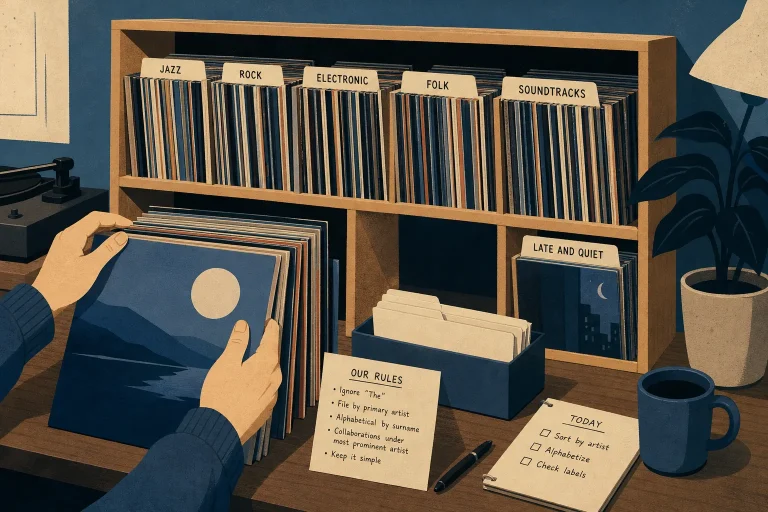
A Record Shelf That Makes Its Collection Easier to Browse
A week of small decisions can turn a crowded record shelf into a system you can…

Listening to an Album Without Reading Along
Set aside the lyrics, reviews, and urge to identify every sound. A simple sequence of listening…