Three Ways to Sequence a Playlist for a Long Train Ride
Mood-led, pace-led, and chapter-based sequencing each shape a journey differently. Choose the approach that suits the ride, then arrange the music so it can carry you without constant attention.
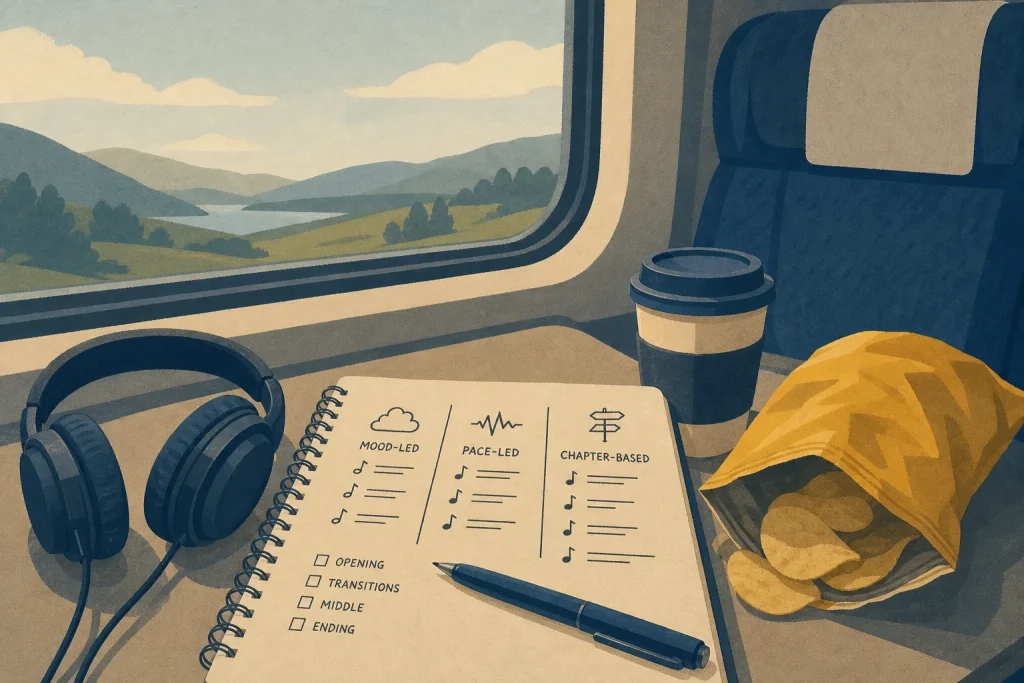
The train pulls away, the platform slides out of view, and someone nearby begins opening a packet of crisps with considerable commitment. A playlist can make the ride feel like a single stretch of time, but its order matters: a run of songs can settle you, keep you alert, or give the journey a shape. Three useful approaches are mood-led, pace-led, and chapter-based sequencing. They solve different problems, so the best choice depends on what you want the ride to feel like.
Which sequencing approach should I choose for my train ride?
Choose mood-led sequencing if you want the music to sustain a feeling, pace-led sequencing if you want its energy to rise and fall, and chapter-based sequencing if you want the journey to feel divided into distinct parts.
Start with the likely character of the trip rather than the playlist length. A quiet ride with a good view may suit gradual changes in atmosphere. A crowded commute with a transfer may call for clear sections and an easy restart. If you tend to get restless, pacing gives you variation without requiring you to check the time.
These methods can overlap, but it helps to pick one as the main organizing principle. Otherwise, the playlist can end up trying to be a landscape, a workout, and a short story at once. That is a lot to ask of a queue.
How does mood-led sequencing work?
Mood-led sequencing arranges songs by emotional color, moving gradually between related sounds rather than following a strict tempo pattern or journey timeline.
Begin by naming the feeling you want to carry: reflective, curious, calm, or quietly upbeat. Then sort candidate tracks by qualities such as brightness, density, vocal intimacy, and instrumentation. A hushed acoustic song and a soft piano piece may sit together even if their tempos differ. A sudden, bright chorus can feel jarring after a subdued stretch, so place it where a shift in feeling would make sense.
For a long ride, avoid treating one mood as a single unchanging shade. A calm playlist can move from close, spare songs toward warmer, fuller arrangements, then settle again. That gives the listener movement without demanding a dramatic emotional turn. Transitions matter: listen to the final moments of one track and the opening of the next, especially when a long fade or abrupt entrance changes the atmosphere.
Mood-led sequencing is a good fit when you want to look out the window and let the music provide continuity. Its weakness is that a narrow emotional palette can become monotonous. Keep some contrast, but make it feel related rather than accidental.
How does pace-led sequencing keep a playlist moving?
Pace-led sequencing shapes energy across the playlist, using changes in rhythmic drive, intensity, and arrangement to prevent the ride from feeling flat.
Think in terms of perceived energy, not just beats per minute. A sparse song with a steady pulse may feel more propulsive than a faster track full of delicate sounds. Group tracks by how much attention and physical energy they seem to demand. Then create waves: a stretch that gathers momentum, a release into quieter music, and another rise when the journey starts to feel long.
One workable pattern is to open with tracks that establish movement, make room for a lower-energy middle, and bring back a little drive later. Avoid stacking every obvious favorite near the start. The playlist may be technically long enough while still leaving the last stretch with the enthusiasm of an empty platform.
Pace-led sequencing suits listeners who want an active soundtrack or need music to offset a dull stretch. It can feel too engineered if every song appears to serve a function. Leave room for a track that simply sounds good, even if it interrupts the neat arc.
How does chapter-based sequencing divide the ride?
Chapter-based sequencing gives the playlist sections that correspond to changes in the journey or in your attention, such as departure, open track, station stop, and arrival.
Unlike mood-led sequencing, chapters can contain more than one emotional tone. Unlike pace-led sequencing, they do not need to create one continuous energy curve. Instead, each section has a local purpose. An opening group might help you settle in; a middle group can support reading or looking out the window; a later group can feel more alert as the destination approaches.
Use clear sonic cues between chapters: a shift from instrumental tracks to songs with lyrics, a change in texture, or a distinctive song that acts like a doorway. If your train makes an unpredictable stop, do not make the playlist depend on exact timing. Organize sections by what they feel like, then resume from the current chapter if the ride is interrupted.
Chapter-based sequencing is especially useful when the trip includes a transfer or when you want to choose music for a particular part without rebuilding the whole playlist. Its risk is making the sections too literal. You do not need a track called “Platform” to establish that the train has stopped.
Can I combine the three approaches without making the order confusing?
Yes. Give one approach the lead and use the others as supporting details. For instance, a chapter-based playlist can keep a calm mood in its first section and gradually increase energy in its last, while still retaining recognizable chapters.
Say you are taking an invented, uninterrupted ride and want to read at first, watch the scenery later, and feel awake near the destination. You could make three chapters for those moments, choose subdued tracks for the reading section, use mood-led transitions through the scenery section, and add a gentle rise in energy near the end. The observable result you would expect is a playlist whose sections feel distinct but do not sound like unrelated queues pasted together.
To keep the design legible, make transitions serve both purposes only when they naturally fit. A song can close a chapter and begin a new mood, but it need not carry every bit of structural work. If the arrangement feels over-explained, remove one organizing rule.
How should I check the sequence before pressing play?
Listen through the order once, paying attention to transitions and to how the middle feels, not just whether the opening is appealing.
Use a music app’s queue or playlist editor to rearrange tracks, then check the following points:
- Opening: Does the first track establish the intended mood or energy without requiring immediate attention?
- Transitions: Do changes in volume, texture, or vocal intensity feel deliberate rather than startling?
- Middle stretch: Is there enough variation to keep a long section from blurring together?
- Chapter cues: If you used sections, can you recognize each one by sound rather than relying only on its name?
- Disruptions: Can you resume after a station stop or interruption without losing the playlist’s basic shape?
- Ending: Does the final group suit arrival, or does it abruptly cut off a mood you wanted to continue?
Make changes only where something feels awkward or repetitive. A sequence does not need to demonstrate its own cleverness. It needs to survive the ordinary conditions of a train: announcements, delays, a conversation you cannot quite ignore, and the occasional snack wrapper with a solo career.
If the ride changes, the playlist can change too. Save a few alternate tracks in the same app or keep the queue easy to edit. The useful sequence is not the one that predicts every part of the trip; it is the one that gives you a satisfying shape while leaving enough room for the train to be a train.
Keep listening
A Record Shelf That Makes Its Collection Easier to Browse
A week of small decisions can turn a crowded record shelf into a system you can…

Listening to an Album Without Reading Along
Set aside the lyrics, reviews, and urge to identify every sound. A simple sequence of listening…